

A quiet revolution is happening in enterprise software.
OpenAI just launched Frontier, an AI agent platform for enterprises that can operate Salesforce and Workday on behalf of humans. Investors in traditional SaaS companies are rattled. Anthropic donated the Model Context Protocol to the Linux Foundation, and it already has 6,400+ registered servers. Google and OpenAI both adopted it within months.
The message is clear: AI agents aren’t coming to enterprise software. They’re already here. And the software they’re inheriting was never built for them.
Think about your CRM. It was designed for a human to log into a web app, click through tabs, type into fields, and hit save. Every interaction assumes eyes on a screen and fingers on a keyboard. Now imagine an AI agent trying to use that same system. It needs structured, typed, deterministic access to data. It needs to ingest raw evidence - emails, transcripts, documents, and extract verifiable claims. It needs to know why it believes something, not just what it believes.
Traditional CRMs can’t do any of this. And bolting AI features onto a human-first architecture doesn’t fix the fundamental mismatch.
The LAMP Stack Moment for AI Agents
Multiple independent analyses this year arrived at the same conclusion: the AI agent stack is standardizing into layers, model, runtime, harness, agent, just like LAMP (Linux, Apache, MySQL, PHP) standardized web development in the early 2000s.
When LAMP emerged, it didn’t matter that you could build a web app from scratch. LAMP made it trivially easy to build a good web app with standardized, interoperable components. The same thing is happening with AI agents. The model layer is commoditizing. The orchestration layer has a dozen solid open-source frameworks. But one critical layer is still missing.
The data substrate.
Where do agents store what they know? Where do they persist CRM data, HR records, financial transactions, project state? Where is the structured, evidence-based memory that agents need to operate reliably in a business context?
Right now, most agent builders wire up a vector database and hope for the best. That works for semantic search. It doesn’t work for a CRM where you need to know the exact deal value, who the decision maker is, and which email confirmed it, with receipts.
Introducing Open Tooling
Today we’re launching Open Tooling, an open-source family of AI-native SaaS tools designed from the ground up for agents.
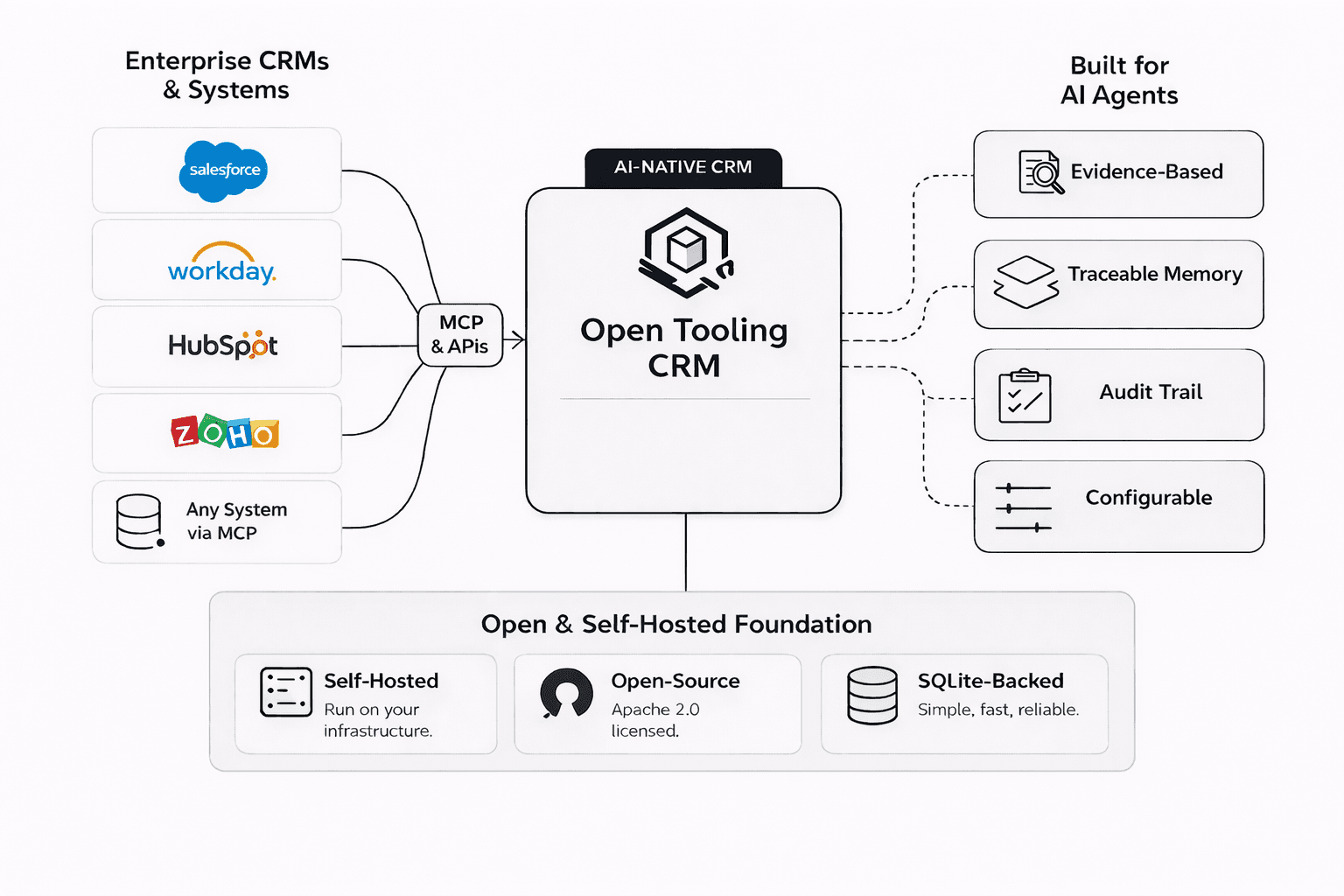
The first module is a CRM. Not because we think the world needs another CRM, but because CRM touches every business, and it’s the clearest example of where traditional SaaS fails agents.
Open Tooling CRM is:
• Headless. No UI. The REST API (29 endpoints) and MCP server (27 tools) are the only interfaces.
• Evidence-first. Every claim traces back to raw evidence through a structured chain: artifacts → observations → briefs → conflicts.
• Local-first. SQLite-backed, zero cloud dependencies. Self-host at a fraction of per-seat SaaS costs.
• MCP-native. 27 tools for Claude, ChatGPT, and any MCP-compatible client.
• Fully configurable. Define your entity types, wire up your integrations, deploy for your specific workflow.
Why Evidence-Based Memory Matters
Most CRMs treat data as flat fields that get overwritten. An agent updates a deal value and the old value vanishes. There’s no record of what changed, why, or what evidence supported either number.
Open Tooling CRM inverts this. The memory layer follows a strict evidence chain:
• Artifacts — Raw, immutable evidence (emails, transcripts, documents). Content-hashed for integrity.
• Observations — Typed claims extracted from artifacts. Each has a lifecycle: current, superseded, or retracted.
• Briefs — Derived summaries that cite observations. Always regeneratable from evidence.
• Conflicts — Explicit records when observations disagree. Never silently resolved.
When an agent tells you “the deal is worth $250K,” you can trace that claim back through the observation to the exact email where the prospect confirmed it. Every claim has receipts.
Intentionally Headless
Open Tooling CRM ships with no frontend. This is deliberate.
Traditional CRMs couple their data layer to a rigid UI. When that UI doesn’t fit your workflow, you’re stuck. Open Tooling inverts this: the data layer and agent tooling are the product. The interface is whatever you want.
With tools like Claude, Cursor, and v0, you can scaffold a full frontend from a natural language description in minutes. The bottleneck is no longer building the UI — it’s having a solid, well-documented API behind it. Or skip the UI entirely: connect the MCP server to Claude Desktop and interact with your CRM through natural language.
The Bigger Vision
CRM is just the first module. The same architecture, headless, local-first, evidence-based, agent-first, applies across the enterprise stack. We’re exploring modules for verticals like HR, Finance, Project Management, Procurement, and beyond. Each will be standalone but interoperable, an integrated, agent-operated back office with full provenance and zero vendor lock-in.
We also built a plugin marketplace for Claude. Install it and Claude instantly understands how to use Open Tooling CRM, the right ingestion patterns, the evidence chain, progressive retrieval.
Get Started
git clone https://github.com/Attri-Inc/open-tooling.git
cd open-tooling/crm && npm install && cp .env.example .env && npm run dev
Three commands. Server starts at localhost:8787. Run npm run seed for sample data.
Use It with Claude (Zero Config)
Open Tooling CRM works with Claude out of the box. Two paths:
MCP Server (Claude Desktop / Claude Code):
Add the MCP server to your Claude config and interact with your CRM through natural language. 27 tools, full evidence chain access, no UI needed.
Claude Cowork Plugin (one-click install):
We built a plugin marketplace that gives Claude the knowledge layer to use Open Tooling CRM optimally — the right ingestion patterns, evidence chain workflow, progressive retrieval, and conflict resolution.
Install in Cowork: Customize → Add plugin → Add marketplace → enter Attri-Inc/open-tooling-plugins → Sync. Then browse plugins and enable the CRM plugin.
See end to end setup demo here.
GITHUB: github.com/Attri-Inc/open-tooling
PLUGIN MARKETPLACE: github.com/Attri-Inc/open-tooling-plugins
Open Tooling is Apache 2.0 licensed. We’d love your feedback, contributions, and stars.