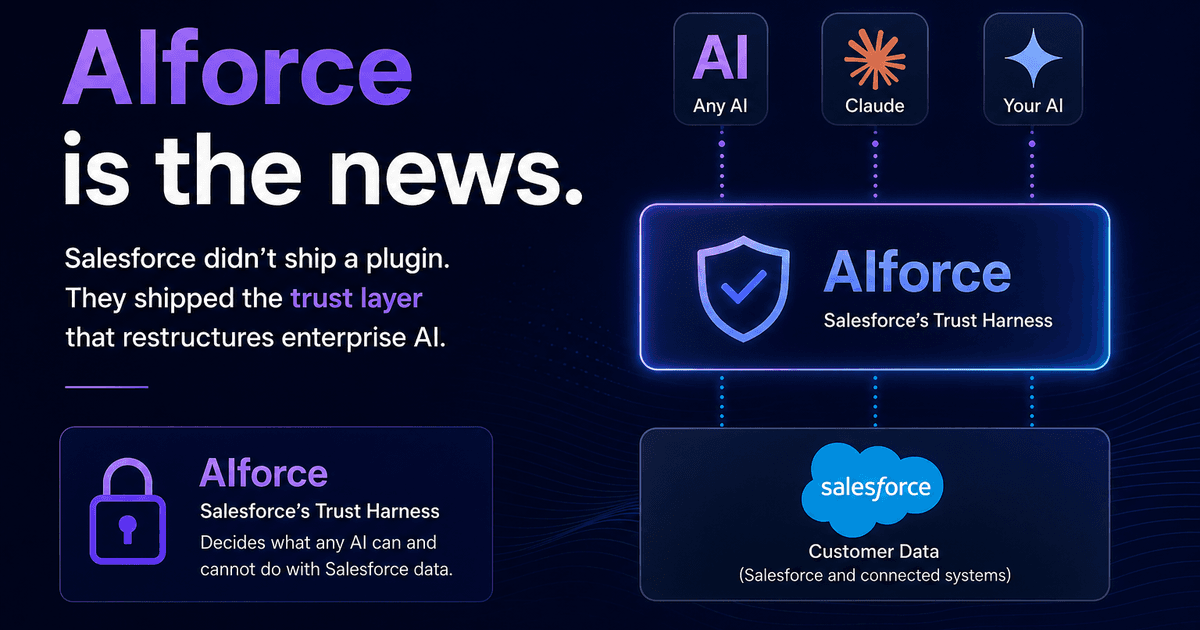
A week ago, Salesforce and Anthropic announced Claudeforce. The first-week coverage focused on the plugin, the 37 sales skills, and the “SaaSpocalypse” quote. Seven days in, with the dust settled, it’s clearer what actually shifted underneath, and it wasn’t the plugin. It was AIforce, Salesforce’s trust harness that decides what any AI can and cannot do with Salesforce data. That single architectural decision restructures the enterprise AI industry. If you’re building enterprise AI, you no longer own the trust layer. You’re a subcontractor inside someone else’s. Here’s the read for founders, CTOs, and buyers, a week later, when it matters more, not less.
Last week, Salesforce and Anthropic announced Claudeforce.
Seven days later, the coverage cycle has mostly moved on. And in the version of the story that’s now settled in the industry’s memory, most of the attention went to the surface: the 37 prebuilt sales skills, the Slack integration, the “#1 AI Meets the #1 AI CRM” branding, Benioff’s “SaaSpocalypse” quote.
Almost nobody named what actually changed underneath.
I waited a week to write this because I wanted to be sure. I’m sure.
The important product wasn’t the plugin. It wasn’t the partnership. It was AIforce.
AIforce is Salesforce’s trust harness, the layer between the customer’s Salesforce data and any AI model that wants to run against it. Not just Claude. Not just today. Potentially yours, too, if you sell AI into Salesforce customers.
That single architectural decision restructures the enterprise AI industry. Because if Salesforce owns the trust layer, every AI vendor selling into a Salesforce customer just moved down one rung in the stack.
You are no longer the AI relationship. You are the party that has to earn the right to run inside someone else’s trust envelope.
That is a completely different role.
The important product wasn’t the plugin. It wasn’t the partnership. It was AIforce. AIforce restructures who owns the trust layer, and that decides who owns the customer.
The old stack vs. the new stack
Two years ago, the enterprise AI stack looked like this:
The customer’s data lived in a SaaS system of record (Salesforce, ServiceNow, Workday)
Your AI vendor product sat on top of that data via API
The customer trusted your governance layer to decide what your AI could do with their data
That structure is now under active reconstruction.
The new stack looks like this:
The customer’s data still lives in Salesforce
Salesforce owns the trust harness that decides what any AI can do with their data
Your AI vendor product is downstream of the trust harness, it runs at Salesforce’s discretion, inside Salesforce’s rules
You are still building product. You are just building product inside a permission system you no longer control.
What this means for AI vendors
Four implications you should have on your Monday calendar:
1. Your policy layer now has to negotiate with someone else’s. You built a policy layer. Salesforce built AIforce. When your customer runs both, someone has to decide which one wins in each situation. Right now, the answer is Salesforce, because they own the data plane. Your policy layer needs to be redesigned to be composable inside AIforce, not defended against it. That’s a different design goal than the one you started with.
2. Your pricing model was based on a different assumption. Most enterprise AI vendors price like they own the customer relationship — annual contracts, per-seat or per-workflow, escalating tiers. In the new stack, you’re a resource inside someone else’s environment. Look at how AWS Marketplace vendors price. That’s closer to where enterprise AI vendor pricing is going. Your CFO should be modeling this before Q4.
3. Your evaluation posture changes. When your customer buys your AI, they now need to know how it behaves inside AIforce. Not just against your own evals. Not just against the customer’s evals. Against Salesforce’s harness. That’s a third evaluation criterion your team should be running against by the end of this quarter.
4. Your competitive moat just shifted. Two years ago, your moat was your governance, your policy layer, your audit trail, the things that made you defensible. Half of those are now assumed by Salesforce. Your new moat has to be what you can do inside their trust envelope that other vendors can’t. That’s a different product than the one you built to compete on defensibility alone.
What this means for enterprise buyers
Three things to add to your next AI vendor review, starting this week:
1. Ask every AI vendor how they run inside AIforce. If they can’t tell you today, they will be able to tell you in 90 days, or they will fall off your shortlist. This is a question you should be asking every vendor conversation you have between now and the end of September.
2. Reprice your existing AI vendor contracts. When Salesforce absorbs part of the governance layer, your AI vendor’s cost structure changes. The cost you’re paying today for their “trust and governance” work is going to duplicate what AIforce provides. Your procurement team should be modeling this before your next renewal cycle.
3. Don’t assume Salesforce is the only place this happens. Microsoft, ServiceNow, Workday, SAP, Oracle — all of them are going to ship their own AIforce equivalents in the next 12–18 months. The trust layer is going to become the same kind of “who owns the enterprise interface” battle that the OS was in the 1990s and the browser was in the 2000s.
Your competitive moat just shifted. Half of what made you defensible, your governance, your policy layer, your audit trail, is now assumed by the SaaS vendor whose customer you serve. Your new moat has to be what you can do inside their trust envelope.
The bigger pattern
This is not about Claude, and it’s not really about Salesforce.
It’s about who owns the trust layer in enterprise AI.
For 30 years, that layer was invisible in enterprise software. It was distributed, the OS did some, the database did some, the application did some. Nobody had to name it because nobody had to negotiate it.
AI collapsed all of that into a specific, urgent question: who decides what the AI can and cannot do with the customer’s data?
The AI vendors thought it was them.
The SaaS vendors are now proving it wasn’t.
Watch for Microsoft’s response. Watch for ServiceNow. Watch for Workday. Watch for SAP. Every enterprise software vendor with a distribution advantage is about to introduce their own AIforce equivalent. Some will call it a trust layer. Some will call it a harness. Some will call it a platform. The name doesn’t matter. The architectural shift does.
By the end of 2027, the biggest question in enterprise AI won’t be “which model do you use?” It will be “whose trust layer are you running inside?”
The Builder’s Takeaways
1. Rewrite your product positioning to work inside SaaS trust harnesses, not against them. The vendors that will win in 2027 are the ones who designed for composability with AIforce, Microsoft’s equivalent, and Workday’s equivalent from day one. If your positioning is “we’re the trusted AI layer,” rewrite it this week. That claim is about to sound like a vendor who missed the shift.
2. Rebuild your pricing model with “downstream of a trust envelope” as the assumption. Not “owner of the trust envelope.” The pricing tier structure that made sense when you owned the relationship makes less sense now. Talk to your CFO before the next annual planning cycle.
3. Add SaaS-harness compatibility to your eval suite as a first-class evaluation dimension. Not an afterthought. Not a “we’ll figure it out later.” A dimension. If your team hasn’t already stood up a test environment against AIforce this month, that’s the first sprint of Q4.
Claudeforce isn’t the story.
AIforce is the story.
And by this time next year, so is Microsoft’s version, and Workday’s, and ServiceNow’s, and the version that hasn’t shipped yet from the SaaS vendor your customer uses that you didn’t think would matter.
If you’re building enterprise AI, this week is when your stack diagram needs a new layer at the top, and the vendor sitting in that layer isn’t you.
The trust layer is the new operating system. Build accordingly.