Here's a pattern I've seen play out more times than I'd like.
A team runs a successful AI pilot. The numbers look great, high accuracy, fast response times, stakeholders impressed. They get the green light. They go live.
Six months later, the AI is quietly being bypassed for anything that actually matters. Nobody made a decision to stop using it. It just... stopped being trusted. And the team is left trying to explain what happened when everything had looked so good.
I've seen this in legal. I've seen it in healthcare. I've seen it at companies that had genuinely strong technical teams and real executive support. The pilot wasn't the problem. What came after the pilot was.
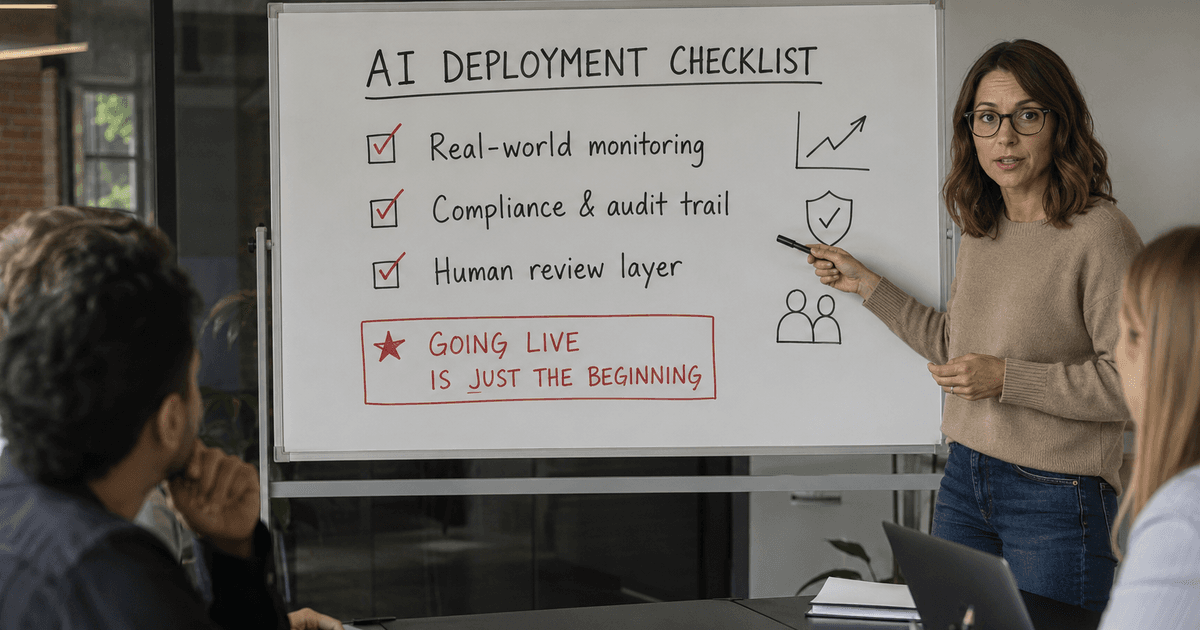
The gap between "it worked in testing" and "it works in the real world" is where most enterprise AI deployments lose momentum. And the organizations that close that gap successfully are doing three things differently.
They know that a test environment is a world you controlled. Production is a world your users control.
When you run a pilot, you test your AI against examples you've prepared, historical queries, carefully selected scenarios, edge cases your team thought to include. You tune until the numbers look good.
But the moment you go live, real users start doing things you didn't anticipate. Not because they're using it wrong, because that's just how people use tools. They find use cases at the edges of what you designed. They ask questions that didn't exist when you built the test. They fold your AI into workflows it was never originally intended for.
The organizations that navigate this successfully aren't just asking "is our AI accurate?" They're asking "is our AI still accurate for the things people are actually using it for today?" Those are different questions, and only one of them shows up in your standard reporting.
They know that a correct output and a compliant process are not the same thing.
This is the one that matters most in legal and healthcare, and it's the one that surprises teams the most.
An AI can give your user a perfectly accurate answer while doing something in the background that wouldn't survive a compliance audit, accessing data in a way that contradicts your policy, skipping a step that a regulator would expect to see documented, generating a paper trail that looks nothing like your internal standards.
The output was fine. The process that produced it wasn't.
You only find out when someone asks for documentation. And in legal or healthcare, someone always eventually asks for documentation.
The organizations that handle this well treat compliance as a real-time requirement, not a launch-time checklist. They have a clear record of what their AI did, how it did it, and what policy was in effect at the time, not because regulators asked, but because they built that in from the start.
They protect the human review layer, intentionally, not just initially.
Every responsible AI deployment I've seen launches with meaningful human oversight. A doctor reviews before the AI recommendation affects treatment. A lawyer checks before the AI-drafted clause goes into a contract. That oversight is what makes the deployment responsible.
Six months later, the review rates have dropped. Not because anyone decided to reduce oversight, but because the AI seemed to be working, people got busy, and the review process quietly eroded.
The failure rate of the AI hasn't changed. The ability to catch failures has.
The organizations that get this right treat their human review layer as a permanent design decision, not a temporary safety net they'll remove once they trust the AI. They set a floor. They monitor that floor. They make a deliberate choice about what level of oversight a given use case requires, and they don't let operational pressure quietly make that choice for them.
The question that separates prepared organizations from the rest
Before your next AI deployment, or before you expand an existing one, ask this: if our AI produces a wrong output six months from now, can we reconstruct exactly what happened?
What was the user's request? What did the AI do? What data did it use? What policy was supposed to govern that interaction? Who was meant to review it?
If the honest answer is "we'd have to go digging", you have a gap worth closing before you go further.
The organizations that build AI that lasts aren't necessarily the ones with the most advanced technology. They're the ones that decided, early, that going live was the beginning of the work, not the end of it.