TL;DR
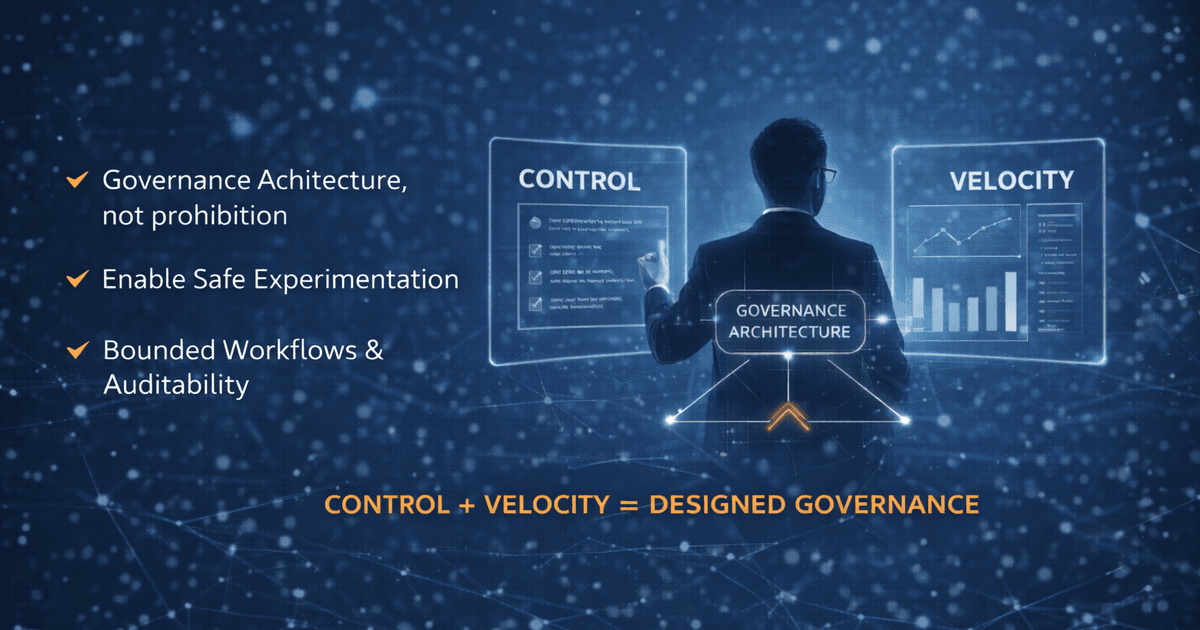
General Counsel face a structural paradox: they must control AI risk while the business demands AI-enabled speed. The solution is governance architecture, not prohibition. By designing secure sandboxes, bounded workflows, and documented oversight, GCs can transform AI from unmanaged risk into managed leverage.
No one experiences the tension of AI adoption more acutely than the General Counsel.
On one side sits the mandate to protect privilege, prevent regulatory exposure, and preserve enterprise trust. On the other sits a business environment moving rapidly toward AI-enabled decision-making, pattern detection, and operational acceleration.
The instinct to slow adoption is understandable.
But unmanaged AI adoption elsewhere in the enterprise poses its own risk. When legal becomes the reflexive “no,” experimentation migrates beyond visibility.
The path forward is not suppression.
It is architecture.
The General Counsel’s role in this moment is to design governance frameworks that allow safe experimentation within clear boundaries. Enterprise agreements that prohibit model training on company data. Defined no-go categories for privileged material. Transparent logging and audit controls. Mandatory human review for high-stakes outputs.
When governance is visible, fear decreases.
When workflows are bounded, risk becomes legible.
When precedent accumulates, confidence compounds.
AI does not have to be an existential threat to enterprise integrity. It can be a managed asset — one that narrows risk signals, accelerates document review, and improves pattern detection — provided it operates within infrastructure that preserves accountability.
The General Counsel’s opportunity is not simply to manage downside.
It is to design the framework within which intelligent speed becomes possible.
Control and velocity are not mutually exclusive.
But they must be engineered to coexist.
The companies that navigate this paradox successfully will not be those that prohibit AI, nor those that deploy it recklessly.
They will be those whose General Counsel choose to architect governance rather than enforce inertia.
Practical: GC governance framework
If you are a General Counsel, consider this phased approach:
Inventory AI usage across the enterprise
Understand what is already happening.
Define clear AI usage policies
Separate low-risk workflows from high-risk ones.
Mandate enterprise-grade tools only
Eliminate consumer tool exposure for sensitive data.
Establish documentation and audit standards
Ensure outputs are traceable and defensible.
Position legal as architect, not obstacle
Enable controlled experimentation rather than blanket resistance. Position legal as the architect of the Legal Exocortex—not the gatekeeper against it.
The companies that navigate this well will not move fastest.
They will move intelligently.
Control and velocity are not opposites.
They simply require design.