There was a particular Tuesday — I won't forget it — where I had six hours of consecutive meetings. Not back-to-back with a five-minute gap to breathe. Literally consecutive. A board prep call bled into a vendor negotiation, which ran late into a cross-functional sync, which somehow ended with an impromptu hiring debrief that nobody had blocked time for.
By the time I surfaced, my inbox had 47 unread messages. Three Slack threads had devolved into people tagging me asking for decisions I hadn't even been briefed on. And somewhere in that chaos, two action items from the morning's leadership meeting had completely fallen through the cracks — not because anyone was careless, but because everyone assumed someone else had picked them up.
This is the part nobody talks about when they talk about senior roles. It's not the big decisions that wear you down. It's the invisible operational weight — the follow-ups, the thread-pulling, the remembering-who-said-what-in-which-meeting — that quietly accumulates until you're spending more time managing information than actually using it.
I'm Chief of Staff and Legal Counsel at Attri. Two roles that, on paper, shouldn't coexist. But in a fast-moving company, they often do — and the throughline between both is that everything depends on context, continuity, and follow-through. Lose any one of those and something breaks.
For the longest time, I managed this the way most people do: obsessive note-taking, colour-coded task lists, calendar blocks labelled "ADMIN — DO NOT BOOK." It worked, mostly. Until it didn't.
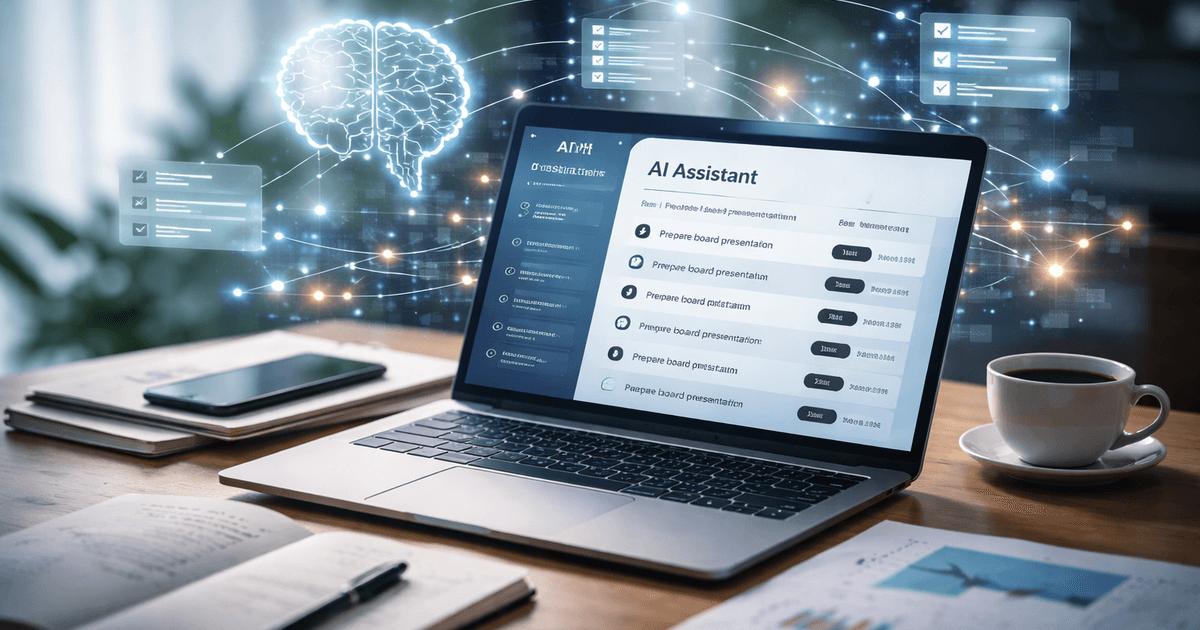
The moment AI stopped being a concept I read about and started being something I actually used wasn't dramatic. It wasn't a single lightbulb moment. It was a quiet Tuesday afternoon — yes, another Tuesday — where I was staring at meeting notes from four different calls and trying to manually consolidate action items into a tracker. Something I had done hundreds of times. Something that took me about 45 minutes and exactly zero of my actual judgment.
I stopped. Pasted everything into an AI tool. Asked it to pull out action items, owners, and deadlines. It took 40 seconds.
I sat with that for a moment.
That's the thing about AI that gets lost in all the noise about robots and job displacement. The conversation always jumps to the extreme — will it replace lawyers, will it replace strategists, will it make entire functions redundant? And while people debate that, they completely skip over the far more immediate and practical question:
How much of your day is genuinely irreplaceable work, and how much of it is just... processing?
Honest answer, for me? When I first actually mapped it out — probably 30-35% of my week was processing. Summarising, reformatting, chasing, consolidating, translating decisions into action. Not thinking. Processing.
AI didn't take my job. It took the part of my job that was quietly taking my energy.
Now, here's where I've watched colleagues — smart, capable, senior people — get stuck. The executives I sit across from who want to use AI but haven't yet tend to fall into one of two traps:
The first is waiting for permission. For a company-wide policy, an approved tool stack, an IT-cleared solution. Some of that caution is legitimate, especially in legal and compliance contexts. But a lot of it is just inertia dressed up as process.
The second is trying to boil the ocean. They want an enterprise-wide AI transformation strategy before anyone touches anything. Meanwhile, their team is drowning in the same 45-minute consolidation tasks I was doing, week after week.
The entry point isn't a strategy deck. It's one workflow. One painful, repetitive, low-risk workflow that you do every single week and have never once thought "this is the best use of my time."
Start there. Seriously. Just start there.
For me it was meeting follow-ups. For someone I work with in finance, it was the weekly status report that took half a day to compile from six different sources. For a lawyer I know, it was the first-pass review of NDAs — not the judgment call, just the initial scan for red flags and missing clauses. In each case, AI didn't make the decision. It did the legwork so the human could actually focus on deciding.
The resistance I understand least is the fear that using AI somehow diminishes the quality of the work. That if a tool helped you, it's not really yours.
I'd push back on that. Hard.
A surgeon doesn't perform worse because the instruments are better. A CFO doesn't lose credibility because they use financial modelling software instead of doing it by hand. We've always used tools to extend what we're capable of. The only reason AI feels different is because it operates in domains — language, reasoning, synthesis — that we've historically considered uniquely human.
But using AI to handle your meeting notes doesn't make you less of a strategic thinker. It makes you one who actually has time to think.
What I've come to believe — and this shapes a lot of the work we do at Attri, where we're building AI agents designed to fit into the way businesses actually run — is that the question isn't whether AI belongs in your organisation. It already does, whether you've sanctioned it or not. The real question is whether you're being intentional about how.
Are you letting it quietly absorb the operational weight so your people can do the work only they can do? Or are you still having the philosophical debate while the Tuesday meetings pile up?
I know which one I'm done doing.