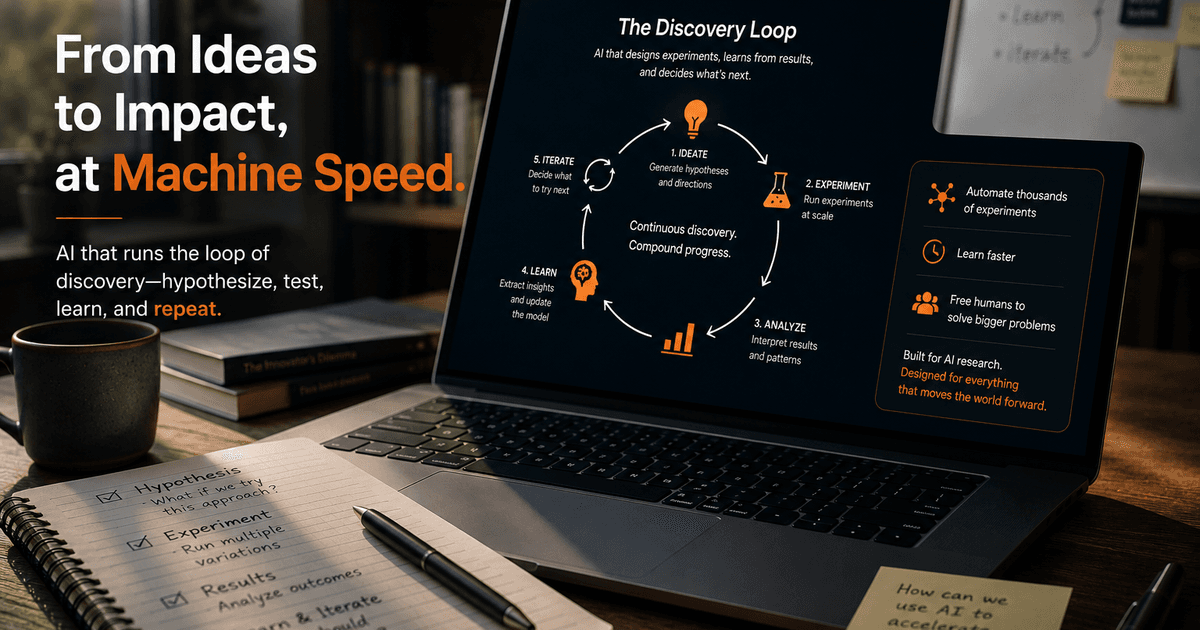
Jeff Dean spent 27 years at Google. He joined in 1999 as roughly employee number 30 and went on to help build some of the infrastructure that made Google possible at global scale, systems like MapReduce, Bigtable, and Spanner. Later, he helped co-found Google Brain and became one of the most influential people in modern AI research.
So when someone like Jeff Dean leaves Google after nearly three decades to start another AI company, I pay attention.
Not simply because another AI startup is interesting, but because of what he has chosen to work on next.
Dean is starting Discovery Loop alongside Sanjay Ghemawat, Quoc Le, and Oriol Vinyals, people whose work spans distributed systems, Google Brain, large language models, Gemini, AlphaStar, and many of the foundations modern AI runs on.
And the problem they've chosen tells us something important about where AI may be heading next.
From generating answers to running loops
Think about how scientific research traditionally works. You form a hypothesis, design an experiment, run it, analyze what happened, learn from the results, and decide what experiment to run next.
Then you repeat the process.
Discovery Loop wants AI to participate across that entire cycle: helping generate hypotheses, design experiments, analyze results, and use those results to determine what should happen next. The company is starting with machine-learning research and engineering, with the broader ambition of applying the same approach to scientific and engineering discovery.
What I find interesting here is that the model isn't really the product. The loop is.
For the last few years, most conversations about AI have focused on what a model can generate. Can it write this document? Can it summarize this contract? Can it answer this question? Can it generate this report?
Those are useful capabilities. But the more interesting question now is: Can AI own more of the loop around the work?
Can it observe what happened, reason about it, take an action, evaluate the result, escalate when necessary, and then continue?
Scientific research is an ambitious example of that architecture, but the same pattern applies to enterprise workflows.
A claims workflow doesn't end when AI extracts information from a document. A legal workflow doesn't end when AI drafts something. A healthcare workflow doesn't end when AI summarizes a patient record.
The real value starts appearing when those capabilities become part of a system that can actually move work forward while understanding where humans need to remain involved.
That is the difference between using AI inside a workflow and redesigning the workflow around AI.
If that's true, we're nowhere near saturation
There's a narrative I hear surprisingly often now: AI is crowded. Everyone has an AI company. The obvious opportunities are already gone.
I'm not convinced.
The foundation-model layer may eventually consolidate around a relatively small number of companies. But the application and workflow layers are nowhere close to finished.
We still haven't figured out how AI should operate reliably inside most real businesses. How should agents interact with existing systems? What context should they have access to? What decisions should remain human? How should organizations evaluate their work? What happens when something goes wrong?
And once you move into industries like healthcare, legal, insurance, or financial services, another set of questions appears around security, reliability, governance, auditability, and human oversight.
Perhaps the biggest question is even simpler:
How do you redesign a business process when intelligence itself becomes increasingly cheap and accessible?
Those aren't solved problems. In many industries, we're only beginning to understand them.
Follow what the builders are doing
Jeff Dean isn't the only senior AI researcher who has decided there is enough unexplored territory to start again.
Ilya Sutskever left OpenAI and founded Safe Superintelligence. Mira Murati left and founded Thinking Machines Lab. Now four people responsible for some of Google's most important infrastructure and AI systems are building Discovery Loop.
I don't think that automatically means startups will beat the incumbents. In fact, Alphabet itself is a founding investor in Discovery Loop, which makes the story more interesting than a simple “Big Tech versus startup” narrative.
But I do think these moves are a useful signal.
The people closest to this technology don't seem to be behaving as though the opportunity has been exhausted.
They seem to be betting that we're moving into a different phase: from asking how capable can the models become? to asking what can enormously capable people and organizations now build with them?
And that second question may ultimately create a much larger surface area for innovation than the first.
The interesting part may only be starting
The next important AI company might not build a better chatbot.
It might redesign scientific discovery. Or legal work. Or healthcare operations. Or manufacturing. Or education. Or something none of us has named yet.
Discovery Loop is interesting because it represents that shift. AI isn't simply being asked to produce another output. It's being inserted into the process of experimentation, learning, and deciding what happens next.
We're still figuring out what happens when intelligence becomes infrastructure.
That doesn't feel like the end of the AI opportunity to me.
It feels like the beginning of the interesting part.
And something new this week, AI in Production is now on Spotify! 🎧
Don’t feel like reading? Listen while driving, walking, working out, or getting through your day.