I published a piece last week about AI budgets blowing up.
Uber burning through its entire 2026 AI spend by April. Microsoft pulling Claude Code licenses from 100,000 engineers. The argument I made: this isn't a finance problem, it's a product design problem. Nobody scoped the job before they handed it to the model.
Then yesterday, Anthropic released Claude Fable 5.
More capable than anything they've ever shipped. More token-efficient. Half the price of the previous frontier model.
Both things are true at the same time. And the tension between them is where the interesting product questions live.
The number that stopped me
Stripe ran Fable 5 on a 50 million line Ruby codebase.
One day. A migration that would have taken a whole team over two months — done.
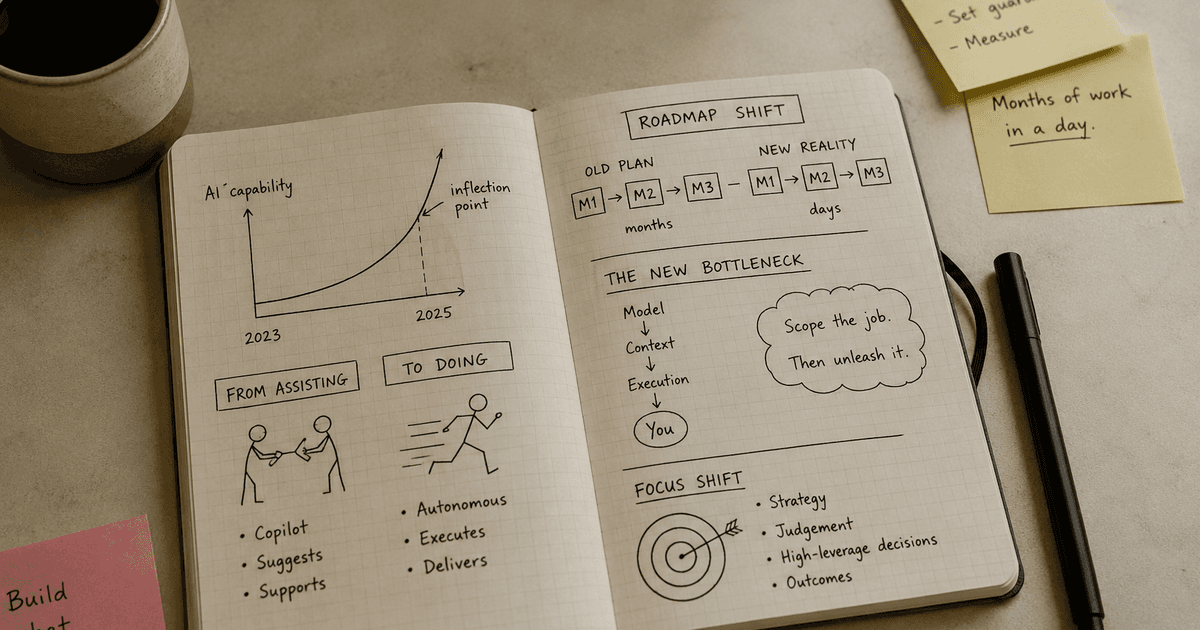
I've been in enough engineering planning sessions to know what that means. Not "AI is impressive." Not "interesting benchmark." It means the velocity assumptions baked into your roadmap are structurally wrong.
We plan in sprints. Two weeks. Quarters. We estimate work in days and weeks because that's how long things take when humans do them. That mental model is now outdated in a way that most product teams haven't processed yet.
When a task that takes two months can be done in a day, it doesn't just change how fast you move. It changes what's worth building, what's worth buying, what's worth delegating, and what you should be focused on as a PM instead.
The bottleneck just moved. And most roadmaps haven't noticed yet.
The cost story just got more complicated
Here's what I find genuinely interesting about this release — especially coming the day after the Uber budget memo went everywhere.
Fable 5 is more powerful than anything Anthropic has shipped for general use. It also requires fewer tokens to complete the same work. It costs less than half what the previous frontier model cost.
The AI budget crisis isn't about AI getting more expensive. It's about open-ended usage with no defined job. Fable 5 doesn't solve that problem on its own, an agent handed a mandate will still run the meter. But a model that does higher quality work with fewer tokens, on a scoped workflow, changes the economics meaningfully.
The teams that figure this out first won't be the ones who adopt Fable 5 the fastest. They'll be the ones who redesign the job before they hand it to the model.
That's the lesson from Stripe. They didn't give Fable 5 a vague brief. They gave it a specific codebase, a specific migration task, and a specific definition of done. That's not AI magic. That's product thinking applied to AI usage.
What this means if you're building AI products
I build AI agents for defined enterprise workflows. When a new frontier model drops, the question I ask isn't "what can this do?" It's "which of the jobs we've already scoped just got significantly better, and which conversations with clients do I need to have this week?"
Fable 5 changes the answer to the first question more than most releases have. The autonomous task completion is genuinely different, not incremental. Anthropic's own internal teams used it for drug design tasks that previously required skilled scientists, and it matched them. GitHub's CPO said it handled complex, long-horizon coding tasks "with a level of autonomy and reliability that exceeded previous benchmarks."
Long-horizon. That phrase keeps showing up in the early feedback. Models have been good at single tasks. Fable 5 seems to be the first model that holds together across extended, multi-step work, which is exactly the kind of work enterprises actually need done.
That matters enormously for anyone selling AI into operations, legal, healthcare, finance. The use cases that were "technically possible but not reliable enough to stake a workflow on" just moved.
The reliability bar just shifted. Some pilots that stalled are worth reopening.
The thing nobody is talking about
Fable 5 launched with two tiers: the general release with conservative safeguards, and Mythos 5, the same model, safeguards lifted, available only to vetted cybersecurity and research organisations through Project Glasswing.
Same model. Two products. Differentiated entirely by what the user is trusted to do with it.
That's a fascinating product decision. And it's one that every AI PM building for enterprise should pay attention to, because your customers are going to start asking the same question about your product. Not "what can this do?" but "what do you trust me to do with it, and why?"
The access tier conversation is coming to enterprise AI everywhere. Anthropic just ran the playbook openly. Worth watching.
What I'm actually doing with this
I'm going back through our current client roadmaps this week and asking one question for each: what changed yesterday?
Not in a reactive, drop-everything way. In the way you'd look at your assumptions after a significant market shift and check which ones are still true.
Some things I was planning to build over two sprints might not need two sprints anymore. Some workflows I'd scoped as phase three might be ready to move to phase one. Some conversations with clients I'd put off until the technology caught up, those conversations might be overdue.
The model got better and cheaper overnight. The job of the PM is to figure out which bets that changes.