Last Tuesday morning at 9am, my phone lit up with an Anthropic press release.
Opus 4.8. The smartest model they've ever released.
I forwarded it to our engineering team. The Slack channel went quiet for about ninety seconds. Then a thumbs-up emoji. Then nothing.
Not in panic. In confirmation.
By 11am, the model upgrade had been merged into our production stack. By 1pm, every agent we run for every customer was running Opus 4.8 under the hood. By 2pm, the engineering team had moved on to other work.
Across all of our customer Slack channels, General Counsels, Chief Risk Officers, CTOs, operations leads, the reaction was the same: nothing. Crickets.
Not because they didn't know. They knew. We'd notified them three weeks before, contractually. They knew the model would change today.
The reason it was quiet is what I want to write about. Because that quiet is the entire point.
Opus 4.8 was the smoothest model upgrade we've ever done, because for our customers, it wasn't an upgrade at all. It was an internal swap they didn't have to know about. That is what production-grade AI looks like in regulated industries.
What happens to most enterprise AI when a foundation model upgrades
Most enterprise AI deployments behave very differently when the underlying foundation model upgrades. Behaviors shift silently. Outputs change at the edges. Edge cases that were handled gracefully a week ago start producing slightly different reasoning. Confidence levels drift. The agent becomes a slightly different employee.
In regulated industries, this is a disaster.
Not because the new model is worse, usually it's better, but because the model is now different from the one the customer signed off on. The eval suite that defined acceptable behavior was passed by Opus 4.7. Does it still pass with Opus 4.8?
For most teams, the honest answer is: "We don't know yet."
For us, the answer was: "It passed every eval the customer signed off on. Including the 47 they added last quarter. Here's the run."
That difference, knowing vs. guessing, is the entire reason regulated-industry customers pay us anything at all.
What makes that quiet possible
A model upgrade can be either an event for your engineering team or an event for your customer. The architectural decision that decides which one it is comes down to four things:
1. The eval suite is the contract, not the model. When Opus 4.8 shipped, we ran our 800-test eval suite against it. Every customer's signed-off behaviour was at the bar. The model had to clear that bar. It did. If it hadn't, we wouldn't have shipped, even though every benchmark in the world says the new model is "better."
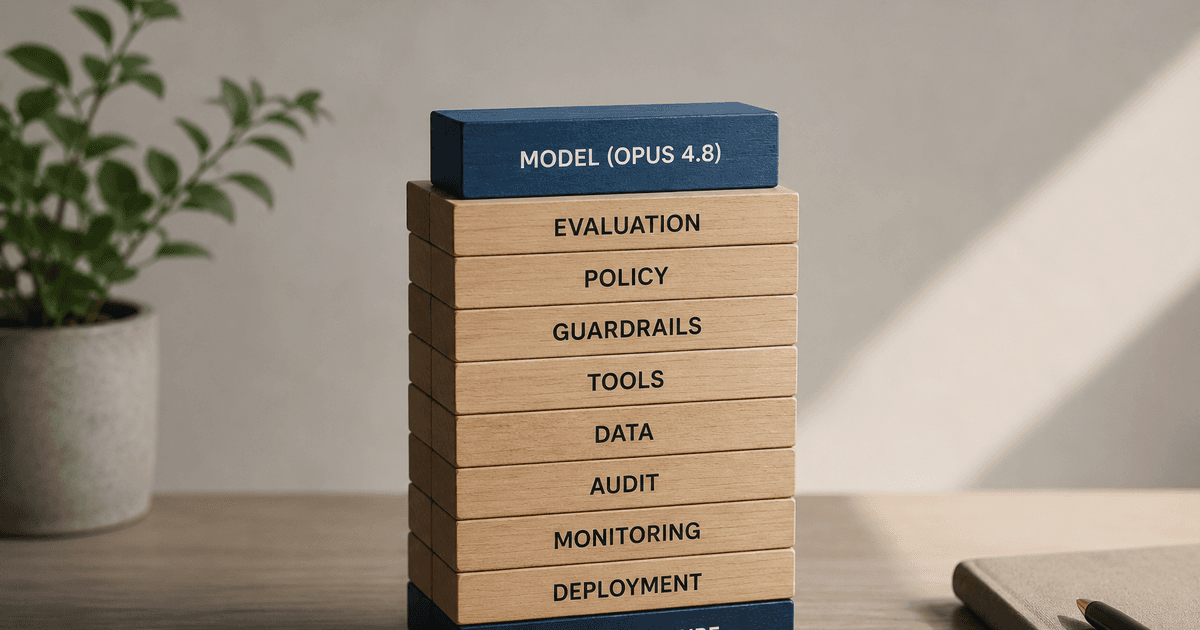
2. The policy layer is versioned independently of the model. Our customers' identity controls, redaction rules, audit logging, retention policies, none of that changed when the model changed. The model is one variable in a stack of nine. We let it move. The other eight stay still.
3. The model swap is a contractual event, not a release note. Customers know the upgrade is coming three weeks before it happens. They get the eval results, the behavior diff, the regression report, and a 14-day window to flag concerns. By the time the model ships, the conversation is already over.
4. The audit trail uses a stable hash. Every decision the agent makes is hashed with a record of what was asked, what was returned, and which model version handled it. Three months from now, if a regulator asks why a specific decision was made, the answer is the same, regardless of which model was running that day.
The model is one variable in a stack of nine. We let it move. The other eight stay still. That isn't a feature. That's the moat.
Why this take, this week
Opus 4.8 is going to be the most-discussed AI release of May. You will read 50 takes about its agentic capabilities, its reasoning improvements, its benchmark scores. I am not writing one of those takes.
I am writing about what happens underneath the model release in production. Because for the customers and operators reading this newsletter, the model release is not an interesting event.
The interesting event is whether your deployment survives it.
If your deployment survives Opus 4.8 without your customer noticing, you have built something durable.
If your deployment shifts behavior in ways your customer can detect, you have not shipped a product. You have shipped a subscription to instability, one that re-prices its own risk every time Anthropic releases a model. That is the most expensive thing a regulated-industry customer can buy.
The Builder's Takeaways
1. Make the model the only variable in your system that can change. Lock everything else, evals, policies, retention, identity, audit. If the model is the variable and the rest is the constant, your customer's confidence compounds release by release. If the model is one of many moving parts, your customer's confidence resets every release.
2. Treat model upgrades as contractual events, not engineering events. Notify customers in writing, before the upgrade ships. Send the eval diff. Send the behavior regression report. Give them a 14-day window to flag concerns. The cost is two weeks of process. The benefit is the rest of the relationship.
3. Have your post-upgrade regression suite ready before the upgrade ships. When Anthropic announces a release, your eval rerun should already be ready to fire, same day, not same week. Two days is too late. By then, the market has moved and your customer has formed an opinion.
Final statement
A General Counsel at a healthcare customer messaged me yesterday morning.
Her message read: "I saw the Anthropic announcement. I assume your team is on it. Let me know when the upgrade lands."
I responded with one line: "Already done. Eval report attached. No customer-facing changes."
She replied with four characters: "Perfect."
That conversation didn't make a press release. It didn't make a benchmark. It didn't trend on AI Twitter.
But that conversation is the entire reason we keep winning regulated-industry deals, and the reason we keep renewing them at the 12-month mark.
The model changed. The contract didn't.
That is what production AI looks like.