"The folder is the agent."
It’s the AI engineering meme of the month. Point a model at a folder. Give it some tools. You have an agent. Forty-four agents at once, if you want. Easy.
It works beautifully. I admire the work behind it.
I have also shipped exactly zero versions of that pattern into a regulated-industry deployment.
Here’s why.
A customer of ours runs a clinical operations team inside a hospital network. Two months ago, one of their engineers tried the "folder is the agent" pattern on a quiet Friday afternoon. He pointed an agent at a folder of clinical notes and asked it to summarize them.
It did.
It also processed forty-three notes it should not have been allowed to see, notes that belonged to a different department, governed by different consent rules, different retention windows, and different jurisdictions under HIPAA.
Nobody got hurt. The notes never left the building. The engineer caught it the next morning. We rewrote the architecture by Monday.
But the moment I keep thinking about is this: the folder did not know any of that. The model did not know any of that. The agent, the thing the engineer thought he was building, did not know any of that.
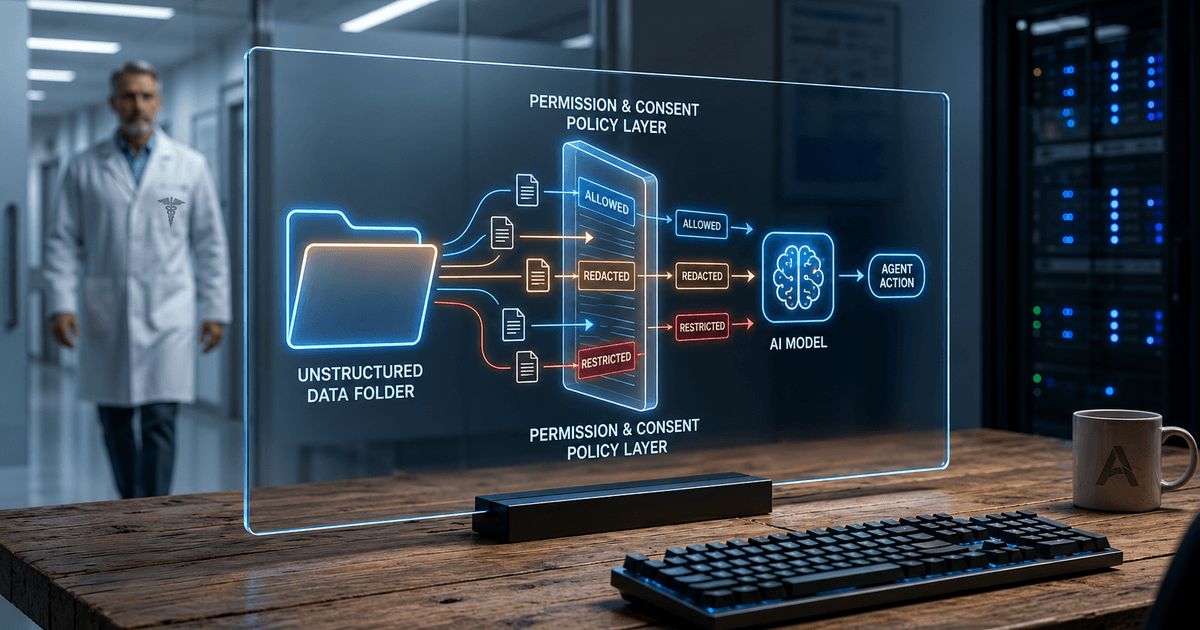
Only the policy knew. And there was no policy layer in the pattern.
In a regulated industry, the folder is not the agent. The folder is just data. The policy that decides what your model is allowed to see, that’s the agent.
WHAT A FOLDER ACTUALLY IS
In a hospital, a law firm, or an insurance carrier, a folder is never just "the files in this directory." A folder is:
• The files,
• plus, an access list that says who can read which file,
• plus, labels that mark which fields are protected (PHI, PII, privileged),
• plus, a rule that says some files can be processed in the US but not the EU,
• plus, a retention rule that says some files officially no longer exist after Day 90,
• plus, a redaction policy that strips out specific fields before anyone sees them,
• plus, a consent record for which patients (or clients) agreed to which uses,
• plus, an audit obligation that logs every read with a stable hash, a named principal, and a stated reason.
The model is reasoning over none of that. None of it lives in the folder. All of it lives in the policy layer that sits between the folder and the model.
In every regulated-industry deployment I have shipped, the policy layer is bigger, more carefully written, and more important than the agent itself. The agent gets rewritten every time the model upgrades. The policy layer is the durable thing. It outlasts three models.
We didn’t build smarter agents. We built better policies. The policy turned out to be the agent.
If you point an agent at a folder in healthcare, you do not get an agent. You get a compliance incident waiting for a clock.
What "policy as the agent" actually looks like
Four things that happen between the folder and the model.
1. Resolves who is asking.
Their role, their team, their stated reason for asking, before any document is even retrieved.
2. Applies the redaction rules.
Strips protected fields from the retrieved data before the model sees a single token.
3. Logs the decision.
What was asked, what was returned, what was stripped, who asked, why. Stable hash. Replayable in five minutes, six months later.
4. Refuses the request when policy says no.
With a structured reason an operator can read and a regulator can audit. Not a 500. Not a guardrail. A documented refusal.
This is not a guardrail. Guardrails are after the fact, they catch the agent’s bad output. The policy layer is before the fact, it catches the agent’s bad input.
That distinction is the entire difference between a healthcare AI deployment that ships and one that becomes a press release nobody wanted.
THE BUILDER'S TAKEAWAYS
How to ship AI in regulated industries without a Friday-afternoon incident
1. Treat your policy layer as the product, not the agent.
The agent is a wrapper around a model that will change next quarter. The policy is the durable, defensible asset. Build it, version it, test it, audit it. The model is the engine. The policy is the car.
2. Apply policy before the model sees the data, not after the model writes the response.
Most teams patch bad behavior on the output side and pray the filter catches it. That’s whack-a-mole. The safe architecture catches the unsafe request at the policy layer, before the model runs. Upstream is cheaper, faster, and far harder to jailbreak.
3. Make every retrieval a decision, not a lookup.
When your agent pulls a document, that’s not a query. It’s a policy-mediated decision: who asked, what role, why, what classification, what consent. Log it that way from day one. The auditor will ask for exactly this six months later, and you will not be able to retrofit it under deal pressure.
The "folder is the agent" framing works beautifully where there is no policy layer underneath. A side project. A Notion workspace. An internal scratchpad. There, it’s elegant. There, it’s right.
The moment you point that same pattern at a hospital, a law firm, an insurance carrier, or anything a regulator watches, you find out fast:
The folder is not the agent.
The folder is just data.
The policy is the agent.