Every AI marketing deck in 2026 sells “fully autonomous.” Every regulated-industry deployment I’ve shipped has taught me the opposite. The most valuable thing an agent can do is the moment of asking for help, asked well.
A radiologist on one of our deployments made a call last week that I keep thinking about.
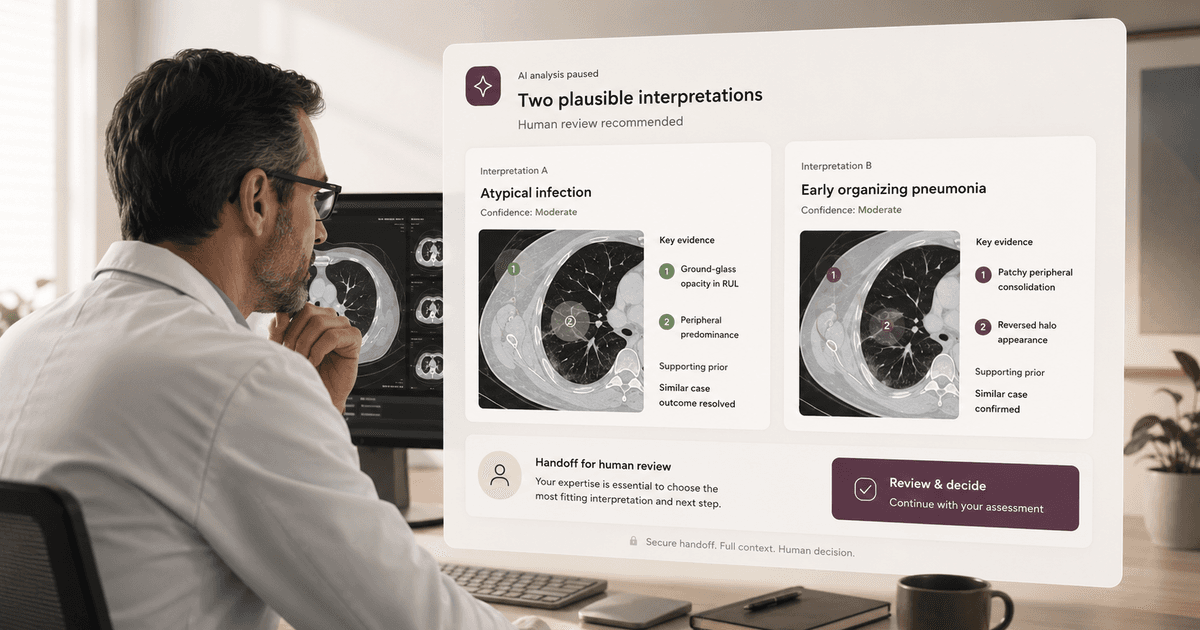
Our agent had drafted a clinical summary on a borderline case, diagnostic imaging with two plausible interpretations. Most agents in our category would have picked one and shipped a confidence score.
Ours stopped. It surfaced both interpretations, cited the imaging that supported each, and said:
“This case is outside the band where I should be the final voice. I need a second pair of eyes.”
The radiologist made the call in under three minutes. She told us afterward that the agent’s framing of the question was more useful than 80% of the second-opinion consults she had done with human colleagues that year.
The agent didn’t deliver the answer. It delivered the question.
That was the product.
In regulated industries, the agent that asks for help well is more valuable than the agent that always answers. Calibrated escalation is the product, not the fallback.
The Escalation Interface
It is not a Slack ping that says “review needed.” It is a structured handoff:
• What the agent would have decided if it were the last reviewer.
• The two or three pieces of evidence that made it uncertain.
• The specific question it cannot answer.
• A recommendation framed as “if X, decide Y; if Z, decide W.”
The reviewer’s job becomes a 90-second decision, not a 20-minute reconstruction.
In clinical contexts, this is the difference between augmenting a physician and threatening one. In legal review, it is the difference between a tool a partner trusts and a tool that gets banned. In claims, a 40-minute escalation becomes a 4-minute one.
We are designing for the escalation, not against it. That has been the single biggest shift in how we ship.
We stopped trying to build agents that never need a human. We started building agents that make the human’s three minutes count.
THE BUILDER'S TAKEAWAYS
How to build for the moment of asking
1. Treat the escalation interface as a feature, not a fallback.
Most teams build it last, as an exception path. Build it first. The quality of your escalation interface is the quality of your product, in any regulated industry.
2. Score your agent on calibrated abstention, not just accuracy.
An agent that abstains correctly 8% of the time is more valuable than one that is 99% confident at 91% accuracy. Build evals that reward “I don’t know, here is what I would need to be sure.”
3. Make every escalation interrogatable.
Each escalation should produce a record: what the agent saw, what it considered, why it stopped. That record is half of your audit trail. The other half is what the human did with it.
The marketing wants you to believe the future of AI is the agent that doesn’t need you. The deployments that win are going the opposite direction.
The most useful thing our agent does, in production, is ask for help.
We built the rest of the product around that one moment.