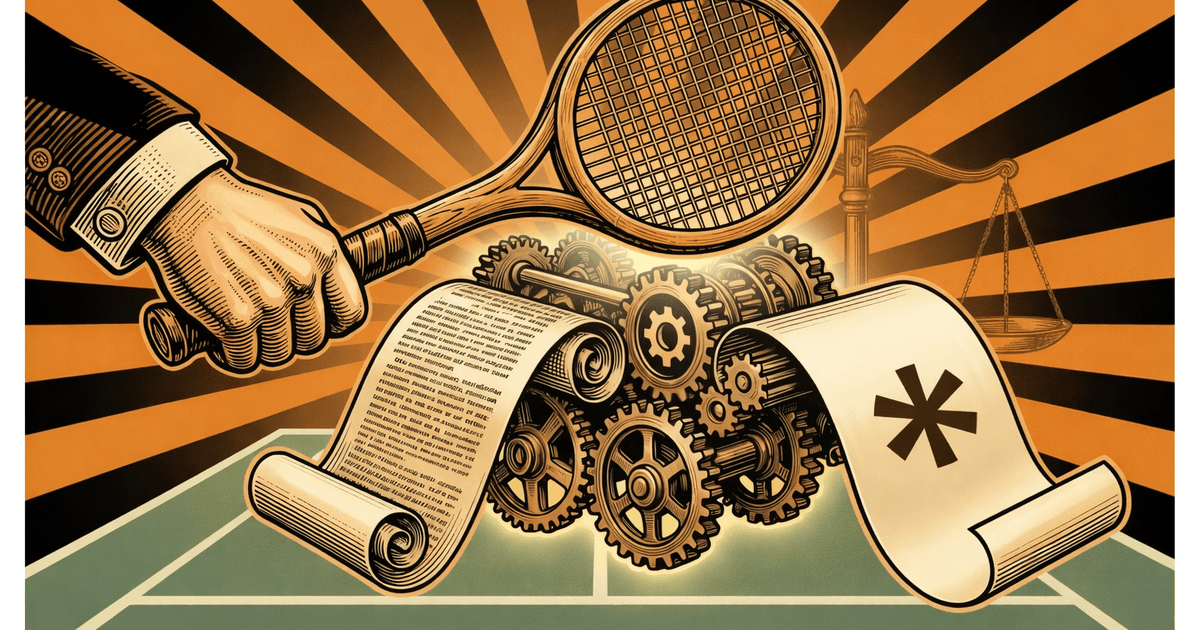
Part 1 of 3 in a series on how we use artificial intelligence (AI) and automation to run legal at Twelvefold Ventures.
It’s 7:02 a.m., Chicago winter, and my strings feel like icicles. I shank the first backhand of the warm-up by a mile.
My coach taps his racquet: “Feet first.”
Twenty-two months in, the big unlocks aren’t new strokes, they’re removing friction and making the right moves automatic: the split step on every bounce, the foot placement before contact, the quick decision to come in on a short ball. Fewer routine decisions mean more energy for the points that matter.
Tennis taught me this: Focus isn’t built on willpower; it’s built on removing tiny frictions.
Legal work is no different. Set the routine, make the easy things automatic, and you reclaim the headspace for the shots that matter.
I didn’t grow up playing a sport year-round. I found tennis as an adult. Learning footwork and patterns from scratch, while already working as a lawyer, forced me to see how much performance relies on the environment you build around your judgment. Tennis has made me a better lawyer (more deliberate, routine-driven), and being a lawyer has made me more analytical and honest with myself on the tennis court.
If you want an extreme version of this idea, look at Rafael Nadal and Novak Djokovic.
Nadal has a famously precise pre-serve ritual: he selects the ball, adjusts his socks, tugs at his shorts, fixes his hair and headband, touches his nose and ears, and bounces the ball in a specific rhythm. He even aligns his water bottles, so every label faces the same way toward the court.
Djokovic leans heavily into data and routines: he and his team obsess over match statistics and video analysis. He is meticulous about what he eats, how he sleeps, and how he trains, crediting this strict preparation with extending his career.
If you want an extreme version of this idea, look at Rafael Nadal and Novak Djokovic.
None of those habits hit a forehand for them. But they give their judgment room to show up at a superhuman level on the points that decide the match.
That’s the mindset I’m trying to bring to legal.
Why I care about this more than is probably reasonable
Before law school, I worked on technology integrations across marketing, finance, and HR, connecting messy systems so people could do real work instead of re-keying data.
As a lawyer, I’ve lived the long nights and the nagging feeling that I could be doing more for clients if the machinery just ran smoother.
Outside the office, I’ve spent years serving on boards and working with organizations focused on civic leadership and access to justice:
The Chicago Bar Foundation (CBF)
Indiaspora
United States–India (US-India) Chamber of Commerce of D/FW
Economic Club of Chicago
South Asian Bar Association Foundation
National Asian Pacific American Bar Association (NAPABA)
National Association of Minority & Women Owned Law Firms (NAMWOLF)
My bias is simple: Technology should give lawyers a better quality of life, help us serve business partners better, and expand access to competent legal help.
That’s the filter I bring to everything below.
The job: GP/GC in an AI-first fund and studio
At Twelvefold Ventures, I wear two hats: General Partner (GP) and General Counsel (GC). Our small legal team covers fund work, studio operations, legal services for a half-dozen portfolio companies, and support for our investment team across millions in AUM.
We work hand-in-hand with portfolio companies scaling scaling fast, while hunting for new investments in a highly competitive space.
In that environment, legal cannot be the bottleneck between a signed term sheet and a closed round. We cannot be the reason a strategic deal slips to the next quarter.
As an AI-first fund and studio, we’ve had weeks where three term sheets, three strategic partnerships, two data processing agreements (DPAs), and a dozen non-disclosure agreements (NDAs) hit the desk at once. By day, I’m negotiating commercial points; by night, I’m turning documents or pushing overflow to outside counsel.
That cycle was the wake-up call. We needed a steadier way to handle volume without lowering the bar.
The week it broke
The week it broke, the load was heavy: three term sheets, three strategic partnerships, two DPAs, twelve NDAs.
I missed a self-imposed service level agreement (SLA), paid outside counsel for a term sheet I could’ve done in an hour, and told a founder we needed “one more day.”
None of this felt like lawyering. It felt like swivel-chair cardio.
The Bridge Moment Around that time, a vendor loaned us an early automation tool for a week. Out of curiosity, I fed it a Master Services Agreement (MSA), a Statement of Work (SOW), and the attached DPA from a complex deal.
Warranty duration: 12 months in the MSA, 6 in the SOW.
Data retention: 30 days in the SOW, 90 in the DPA.
Audit rights: Mutual in the MSA, unilateral in the DPA.
None were fatal. But finding them fast changed the conversation. Instead of hunting for issues, I was deciding what mattered.
That was the epiphany: Automation wasn’t about writing our contracts for us; it was about shortening the path to judgment.
Once I saw that, I couldn’t unsee it.
There’s another path
The path that scales better is simple: treat legal as a managed process. Wrap the highest-friction work in narrowly scoped, auditable automated workflows (think “agents” as aides”) that prepare drafts and route matters for attorney review and approval.
The objective is predictable turnaround, with controls and an audit trail.
The question became: What made this possible now that wasn’t true ten years ago?
What changed (and why this is the moment)
Since March, our inbound legal requests have grown 63 percent while headcount stayed flat. That isn’t a scheduling tweak; it’s a capacity gap, and the perfect candidate for structured automation.
Three shifts made this practical.
1. Reliable automation tools
Tools can now extract key terms and compare clauses with enough consistency to reduce manual glue work, without pretending to make legal judgments.
For years, contracts and policies were too unstructured for software. They are rich in nuance and, historically, terrible for code.
Modern language models changed that. They map words to meanings well enough to turn free-form text into working structure. That makes previously manual hand-offs viable, and it raises our bar for what “practical” looks like.
We’re not asking the machine to “do law.” We’re asking it to read, organize, compare, and surface. Judgment stays with humans.
2. Better integrations
Now that systems can exchange meaning, not just files, CLM platforms, e-signature tools, ticketing systems, and CRMs connect without a ground-up rebuild.
That means fewer copy/paste hops, less re-keying, and less context loss between systems.
That means fewer copy/paste hops, less re-keying, and less context loss between systems.
3. Auditability by default
The profession asks for zero fallibility in principle and full accountability in practice. Culturally, we are allergic to “the system did it.”
Audit trails solve this. They turn hard conversations (“Why did this slip?” or “Who approved that term?”) into concrete improvements.
Instead of “we think,” you can say:
Here’s the request.
Here’s the playbook snapshot.
Here’s how the draft was prepared.
Here’s who approved it.
The Lawyer’s Role (Non-delegable Judgment)
All of this only works if we’re very clear about what lawyers still own.
Set policy and playbooks: Counsel defines acceptable positions, fallbacks, and escalation thresholds, by document type and business context.
Approve deviations: Any variance from policy requires explicit attorney sign-off (named approver, timestamp, rationale).
Communicate expectations: Lawyers own the client relationship, SLAs, and risk updates.
Own final documents: Automated steps prepare; attorneys finalize.
Supervise and train: Workflows are tools; they operate under attorney supervision, including supervision of non-lawyer aides and vendors.
Personal stacks, professional judgment Not every lawyer needs the same tools. Some of us are best at drafting, some at negotiation strategy, some at client communication. A humane tech stack lets each attorney shore up their weak spots so they can spend time where they add value.
A secure place to experiment
Before we built anything serious, we stood up a legal sandbox: a secure, isolated workspace where we could load documents, enforce information barriers, and try new workflows without that stomach drop of wondering if you just accidentally emailed a test script to a client.
We insisted on a real security baseline: SOC 2 Type II; HIPAA add-ons if touching PHI; single sign-on, role-based access; and strict dev → stage → prod environments with versioning and rollback.
We added one human detail that mattered: A simple “Expected X, Observed Y” button that sends IT a reference ID and the relevant materials.
The cultural message was clear:
You can put docs in here without fear. If something behaves oddly, it’s a system issue, not a personal failure.
What’s next
In Part 2, I’ll zoom into one concrete use case: NDAs. You’ll see how we built a traffic light system—Red/Yellow/Green, that gave business partners reliable ETAs while keeping attorneys in charge.
In Part 3, I’ll walk through the 180-day roadmap and governance framework we used to roll this out across more workflows —without spooking ourselves, our board, or our counterparties.
Tennis made my split step automatic so I could focus on the ball. This is the same project in the office instead of on the court.