Last week I wrote "AIforce is the news. Not Claudeforce," arguing that the Salesforce-Anthropic announcement's most consequential product was Salesforce's trust harness, not the plugin, not the partnership, not the sales skills.
Two weeks in, that read is holding. The coverage cycle moved on. The trust-layer question didn't.
The response I got from that piece was almost entirely one question, in three different phrasings:
"OK. What do we do about it?"
That's this week's issue.
Because if you're an AI vendor selling into a Salesforce customer, or into any SaaS customer where a trust harness is coming, sitting still isn't a viable move. Salesforce has already made a decision that affects your product. The next 90 days are about the decision you make in response.
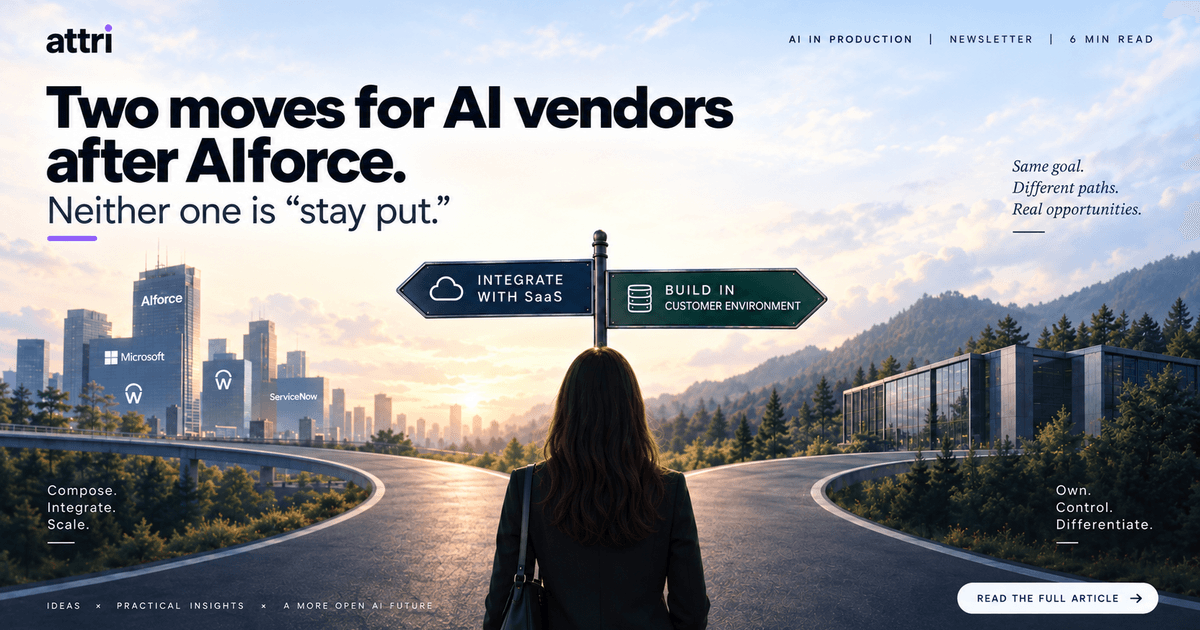
There are exactly two moves. Let's walk through them honestly.
The coverage cycle moved on. The trust-layer question didn't. If you sell AI into Salesforce customers, sitting still is not a viable move, Salesforce has already made a decision that affects your product. The next 90 days are about the decision you make in response.
Move 1 · Become the best subcontractor inside SaaS trust envelopes
The move: You accept that Salesforce owns the trust layer for Salesforce data. You redesign your product to compose with AIforce, not against it. You add SaaS-harness compatibility to your eval suite as a first-class dimension. You reprice with "downstream of a trust envelope" as the assumption. When Microsoft, Workday, and ServiceNow ship their equivalents, you do the same for each.
When it's right: Your buyer is a Salesforce customer who is not going to move off Salesforce. Your product's value is largely in what it does inside a specific SaaS surface, sales enablement, service ops, marketing automation. The customer doesn't especially care where the compute happens as long as it works inside their existing tools.
What it costs: Your product roadmap for the next 18 months is now partially controlled by the SaaS vendor. Every one of their AIforce releases becomes a P0 integration project for you. Your pricing power compresses toward marketplace economics. Your competitive moat has to migrate from "we own the governance layer" to "we do specific things inside their governance layer that no one else can." That's a different product than the one most enterprise AI vendors have built.
Who's doing this well: The AI vendors already deep inside the Salesforce partner ecosystem, mostly workflow-layer companies with clear per-workflow value props. If you're in this camp, your Q4 project is depth of integration, not breadth.
Move 2 · Build in the customer's environment, where the customer owns the trust layer
The move: You stop trying to be inside Salesforce's trust envelope at all. You give your customer a stack they run in their environment, self-hostable, open-source, headless, MCP-native. The customer's data plane stays under their control. The trust layer stays under their control. Your product is the code, not the endpoint they call.
When it's right: Your buyer is in a regulated industry, has strong data-sovereignty requirements, or has specifically told you they don't want to be locked into another SaaS vendor's governance layer. They already run open-source infrastructure elsewhere. They have a security team that would prefer to read your code than take your compliance statement.
What it costs: This is a fundamentally different product model. You're distributing code, not running SaaS. Your business model shifts from usage/seat billing to support, managed hosting, and enterprise-tier features. Your GTM changes from marketing-led to community-led. It's a bigger reset than Move 1. But the ceiling is also higher, because the customers who want this really want this, and the vendor lock-in cycle you're competing against is exactly the one Salesforce just made worse.
Who's doing this well: A small but growing set of teams building open-source, self-hostable AI infrastructure specifically for regulated enterprises. Twenty (open-source CRM), Relaticle, and, the reason this matters to me personally, what we've been building at Attri for the last two years under the name OpenCRM.
Which move is right for you
Three questions decide it:
1. Who is your buyer's actual boss on data governance? If it's Salesforce (or their SaaS vendor of choice), Move 1 is your path, you're going to be inside that trust envelope whether you like it or not.
If it's the customer's own CISO or CIO, and that person has specifically pushed back on additional SaaS trust dependencies, Move 2 is on the table and probably preferred.
2. Where did your defensibility live 12 months ago? If most of it was in your governance layer, policy engine, and audit trail, Move 2 preserves that moat. Move 1 gives half of it away to Salesforce.
If most of it was in your specific workflow expertise, your training data, or your integration depth, Move 1 keeps that intact. Move 2 doesn't add much.
3. How high are your customer's data-sovereignty requirements? Legal, healthcare, defense, wealth-management: Move 2 is probably the only move that survives their next security review.
General SaaS, sales tools, marketing automation, mid-market operations: Move 1 is fine and probably the right choice.
You can, in theory, run both moves in parallel, a SaaS-composable product for Move 1 customers and a self-hostable version for Move 2 customers. But most teams don't have the engineering or GTM bandwidth for that. Pick the one your best customer is asking for.
If your defensibility lived in your governance layer, Move 2 preserves that moat. Move 1 gives half of it away to Salesforce.
What we've been building: OpenCRM
For the last two years, Attri has been building for Move 2.
OpenCRM is the headless, open-source, MCP-native, self-hostable CRM we shipped to make this move possible for other teams. Twenty-nine REST endpoints. Twenty-seven MCP tools. Apache 2.0. Runs on the customer's laptop, VPS, or VPC. Data stays where they put it. The customer's trust layer is the customer's, not a SaaS vendor's.
We didn't build it as a response to AIforce. We built it because two years of customer conversations in construction, legal, and healthcare told us the same thing every time: "our security team is not going to sign off on another SaaS vendor holding our customer data plane." AIforce is why that conversation just got faster and louder in a lot of other industries.
If you're an AI vendor looking at Move 2 and thinking "but I don't want to build the whole CRM stack from scratch just to keep my customer's trust envelope theirs," OpenCRM is one answer to that. Fork it, embed it, ship on top of it. Or use it as the reference architecture for what your equivalent would look like.
Repo: github.com/Attri-Inc/open-tooling
Same architecture pattern powers OpenWatch (agent observability) and OpenLedger (financial system of record), the other two Attri products in the same family. Different domains. Same idea: the trust layer stays with the customer.
The Builder's Takeaways
Three moves for this week, whichever direction you're heading.
1. Pick your move by end of September. Move 1 or Move 2, both are hard, and both are viable. What's not viable is running the rest of Q4 without picking. If your engineering team is still building against yesterday's assumptions about who owns the trust layer, every week that passes is a week of work you'll have to redo.
2. If you're doing Move 1, stand up a test environment against AIforce in the next 30 days. Don't wait for a customer to ask you how you compose with it. Get ahead of the question. The vendors that will win the SaaS-composable game are the ones with real integration by Q1 2027, not the ones announcing plans then.
3. If you're doing Move 2, invest in your customer's on-prem or VPC deployment story now, not later. The vendors that will win the customer-owned-trust-layer game are the ones whose install is one command and whose data model the customer's engineering team can audit in an afternoon. Every day of friction in your self-host story loses you a Move 2 customer to a competitor who has smoother onboarding.
Two weeks ago, Salesforce moved the trust layer.
Last week, I named what happened.
This week, every AI vendor selling into Salesforce customers has to pick a move.
Move 1 is compose with the harness. Move 2 is give your customer a stack where the harness is theirs.
Move 3, sit still and hope no one notices, is not on the list.
The teams that pick early and commit will spend Q4 building. The teams that debate the choice through October will spend Q1 remediating.
Sources & referenced pieces
Last week's issue: "AIforce is the news. Not Claudeforce." — https://www.linkedin.com/pulse/aiforce-news-claudeforce-ayush-patel-mjssc/
Claudeforce announcement (August 26, 2026): https://investor.salesforce.com/news/news-details/2026/Salesforce-and-Anthropic-Announce-Claudeforce-The-1-AI-Meets-the-1-AI-CRM/default.aspx
OpenCRM (Attri, Apache 2.0): https://github.com/Attri-Inc/open-tooling
Attri Open Tooling family (OpenCRM · OpenWatch · OpenLedger): https://open-crm.ai
🎧 Listen to this issue on Spotify: https://open.spotify.com/episode/27V8ZECtsd1v3hFDZyrtua?si=zfPqiB65SD2KRa83u4IN4Q&nd=1&dlsi=bba4212d6cbb430f