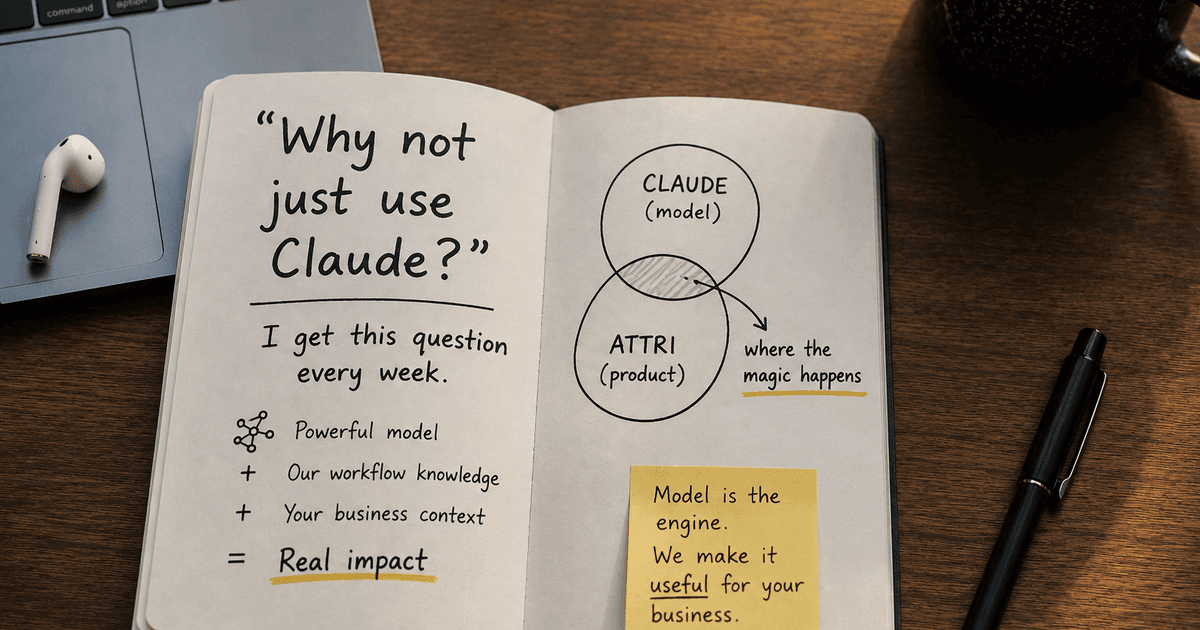
Last week I was in the middle of showing a prospect our product.
We were deep into a workflow walkthrough, the kind of session where you can feel the room starting to get it, where the questions are getting more specific and less skeptical. And then, right in the middle of it, one of them leaned back and asked:
"Don't you think Claude can do this?"
I've been asked versions of this question more times than I can count. Sometimes it's Claude. Sometimes it's ChatGPT. Sometimes it's Gemini. The model changes. The question doesn't.
And I'll be honest, the first few times I heard it, something tightened in my chest.
The question that changes everything
Here's what "why not just use Claude?" is really asking.
It's not a technical question. It's a trust question. It's a prospect sitting across from you, or across a Zoom call, trying to figure out whether you're building something genuinely different, or whether you've wrapped a ChatGPT interface in a nice UI and called it a product.
That's a fair question. A necessary one. And the fact that it's being asked more often, more directly, as every frontier model release makes foundation model capabilities more visible, that's not a threat. It's the market doing its job.
The companies that can't answer it clearly deserve to lose those deals.
The companies that can answer it, quickly, confidently, without getting defensive, are the ones that actually understand what they're building.
We had to earn that answer. It took us a few versions to get there.
What I've said, and what I've learned
The first version of my answer was about features. Here's what our product does that Claude doesn't. Here's the list.
The problem with the feature answer is that it has an expiry date. Whatever Claude doesn't do today, it might do next month. And it usually does. Anthropic ships weekly. OpenAI ships weekly. Any answer that starts with "Claude can't do X" is one model release away from becoming wrong.
The second version was about the user. Claude is built for anyone who knows how to use it, which means it works brilliantly for developers, researchers, curious power users. But the people who need to fix a broken referral workflow at 2pm on a Thursday aren't thinking about how to prompt an AI. They're thinking about the referral. We're built for them, pre-configured, pre-contextualized, requiring zero AI literacy to operate. Claude hands you a blank canvas and enormous capability. We hand you the thing that's already painted for your specific wall.
Better. But still not quite right.
The third version, the one that actually lands, is this:
Claude is one of the most powerful AI models in the world. It can do remarkable things. But it doesn't know your business. It doesn't have your workflows pre-loaded. It doesn't understand the specific way your team handles a referral, or routes an approval, or manages an exception. It hasn't been trained on the context of what "done" looks like in your organization.
We have that context. We've built it in. Claude is the engine. We're the product that makes the engine useful for your specific business, without your team having to become prompt engineers to get there.
That answer doesn't apologize for Claude being powerful. It respects it. And it's clear about where Attri lives, in the space that foundation models will never fully occupy, because that space is yours.
The model is a commodity. The workflow knowledge, the integrations, the business context, that's the product.
What every new model release actually does to us
When Anthropic ships something new, I go through a version of the same process from four different seats.
As a PM, I'm asking: does this change our roadmap? Is there a feature we were planning to build that we should now deprioritize because the model now handles it natively?
As a GTM person, I'm asking: does this change how we position? Is our messaging still accurate, or do we need to shift where we draw the line between us and the model?
As a salesperson, I'm asking: how do I answer the question when it comes up this week? What's my thirty-second version?
As a marketer, I'm asking: how do we communicate this externally in a way that doesn't make us sound scared or confused?
Most PMs at AI startups only feel this from one of those seats. I feel it from all four simultaneously. And the honest answer is that it's made us better at each one, because it forces you to be really clear about what you're actually selling.
The companies that struggle when a new model drops are the ones whose product was competing at the model layer, trying to be a better general AI. When Anthropic ships something better, their whole value proposition moves.
We made an early call to stop competing at that layer. Not because we couldn't, but because the smarter bet was to go deeper into specific workflows, specific business contexts, specific user types who need the thing to just work without configuration. Enterprise operations teams don't want to prompt an AI. They want a tool that understands their business and gets out of their way.
That positioning doesn't get weaker when Claude gets smarter. It gets stronger, because a more powerful model underneath a well-designed workflow product means the product gets better too.
When your foundation gets upgraded for free, your product gets upgraded with it. That's not a threat. That's leverage.
The question I want customers to ask now
Something shifted in me around the sixth or seventh time I got asked "why not just use Claude?"
I stopped feeling defensive. I started feeling ready.
Because by that point, I had a real answer. Not a rehearsed deflection. An actual explanation of what we are, what we're not, and why the distinction matters for the person sitting in front of me.
The question that used to feel like a challenge now feels like the beginning of the real conversation. The customer who asks it is telling you something important: they're paying attention. They want to understand. They're not sold yet, but they're trying to be.
My answer has gotten cleaner every time I've been asked. The messaging has gotten sharper. The product has gotten more focused. All of it, because of the pressure that question creates.
I don't want Anthropic to stop building. I don't want OpenAI to slow down. The better the foundation models get, the more valuable the layer we've built on top of them becomes, because the capabilities we're directing toward specific business problems get more powerful every quarter.
The companies that will lose are the ones building directly into the path of that wave.
We're not trying to stop the wave. We're trying to surf it.
I'm Sakshi, AI Product Manager at Attri. We build AI agents for specific, high-value enterprise workflows. I wear a lot of hats — product, GTM, sales, forward deployed engineering, and I write AI Product, Unfiltered because the honest version of building AI products at a startup deserves to be told. Always happy to connect.