Thursday, July 2nd was a strange day to be an AI optimist.
At an internal town hall, Zuckerberg told Meta employees that agent development hadn't accelerated the way executives expected it to. This from the company that laid off roughly 8,000 people earlier this year, about 10% of its corporate workforce, and reassigned another 7,000 into AI groups, including one literally named Agent Transformation. The upside of that restructuring, he conceded, hasn't materialized yet. Meta is on track to spend as much as $145 billion on AI infrastructure this year.
The same morning, Microsoft announced Microsoft Frontier Company: a $2.5 billion operating business with 6,000 industry and engineering experts, dedicated to one thing, getting enterprise AI deployments to actually deliver outcomes. Launch partners include the London Stock Exchange Group, Unilever, Land O'Lakes, and Accenture.
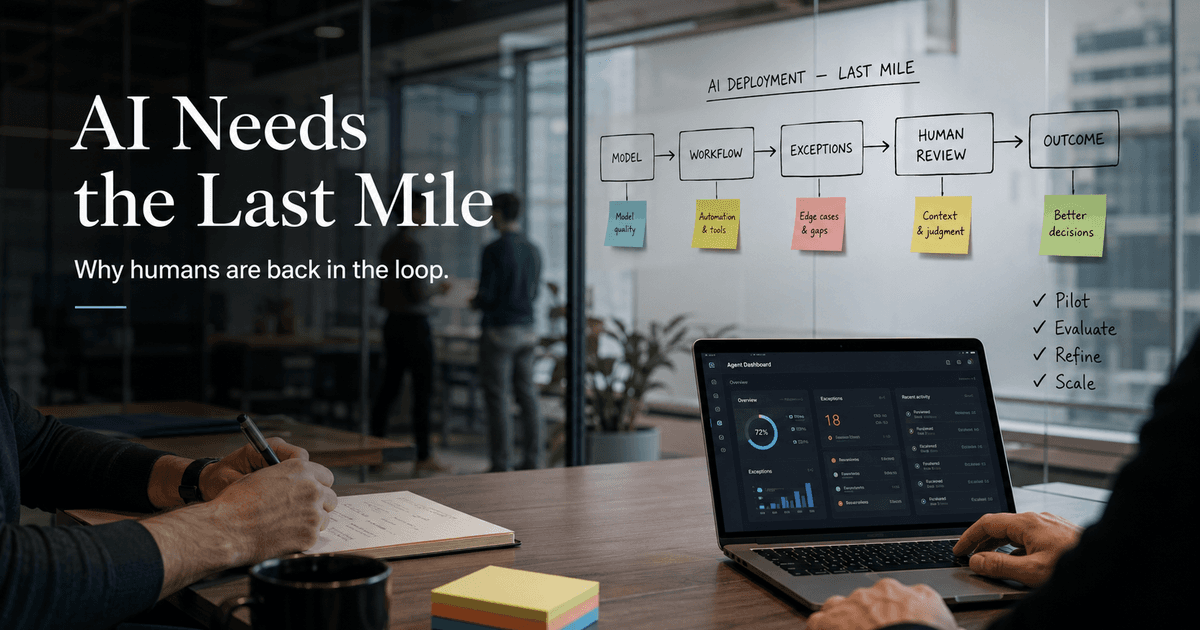
Two days before that, Amazon committed $1 billion to its own deployment org, explicitly embracing the Forward Deployed Engineer model. OpenAI and Anthropic launched similar joint ventures back in May. Microsoft's commercial chief insisted their version goes beyond what's been labeled forward-deployed engineering. Call it whatever you want. The math is the math: the four loudest companies in AI just committed more than $4.5 billion to putting humans between their models and their customers' outcomes.
The industry is telling on itself
Read those announcements together and the subtext is impossible to miss.
If frontier models plus an enterprise license produced business outcomes on their own, none of these ventures would need to exist. Microsoft would not need 6,000 experts. Amazon would not need a billion dollars. The entire premise of these organizations is that the gap between "the model can do it" and "the workflow reliably does it" is so large, and so valuable, that it justifies standing up a whole company to close it.
And it's not just tech. In late June, Ford disclosed it had rehired 350 veteran engineers, the internal nickname is "gray beards", after its automated quality systems underdelivered. A Ford VP admitted they mistakenly assumed that simply introducing AI "would produce a high-quality product." The rehired specialists now hunt failure points and retrain both the junior staff and the AI tools. Ford expects the move to cut a billion dollars in cost this year.
Replace the humans, stumble, hire the humans back to make the AI work. That's not an AI failure story. That's the industry discovering, expensively and in public, where the product actually lives.
The model was never the product
Here's the reframe I keep coming back to: nothing about the models got worse this quarter. They're better than they were in January. What collapsed is the assumption that capability alone converts into outcomes.
The demo is capability. The product is everything else, the workflow mapping, the context engineering, the integration into systems that were never designed to talk to each other, the trust-building with the people whose job the AI is supposed to make easier. That layer doesn't ship in a model release. Someone has to build it, per customer, in the customer's mess.
I know because that layer is my actual job.
At Attri, I wear the forward deployed hat alongside product. What that means in practice: the work that makes our healthcare deployments succeed almost never happens in the model layer. It happens sitting with the people who run the workflow today, finding out that the "simple" referral process has eleven exception paths nobody wrote down, that the data lives in three systems with two owners, that the coordinator who's supposed to love the automation is quietly working around it. No benchmark captures any of that. Every successful deployment runs through it.
For two years, this work got dismissed as "services", the low-margin stuff real product companies avoid. Microsoft just called it the most capable outcome-driven engineering organization in the industry and put $2.5 billion behind it. The thing everyone treated as overhead just got repriced as the moat.
Three things that change on your roadmap
Deployment effort is now a product metric. If your product needs three months of embedded engineers to produce value, that's not a go-to-market problem, it's a design decision you made, the same way cost-per-workflow was in the budget piece I wrote in May. The question for every feature: does this shrink time-to-outcome in a real customer environment, or does it demo well and deploy badly?
Design for the human in the loop, because there is one. Meta bet on agents replacing workflows wholesale and is now telling staff to wait three to six more months. Ford got quality back by pairing AI with veterans who reprogram it. The products winning procurement right now aren't the most autonomous, they're the ones honest about where humans stay in the loop and ruthless about making that loop tight.
Your product can't ship with a docs page and a dream. If Microsoft needs 6,000 humans to make its own AI land inside the Fortune 500, self-serve onboarding is not going to carry your agentic product into a real enterprise workflow. Budget for the last mile in the product itself, templates, workflow mapping, exception handling, or accept that someone else's FDE team captures your margin.
What I actually think this means
There's a pessimistic read here: agents are behind schedule, Big Tech is hedging, the autonomy story is quietly getting walked back.
I read it the opposite way.
When the biggest companies in the industry price the deployment gap at $4.5 billion, they're not admitting defeat. They're telling you exactly where the market is. Big Tech's answer to the gap is thousands of expensive humans. That's the incumbent solution, and the honest objection to everything I've written here is that maybe humans are just what enterprise AI deployment costs. Maybe the gap can't be productized.
I don't buy it, because I've watched the gap shrink when you treat it as a design input instead of a services problem. On our referral platform, the first deployment taught us that every health system has its own exception paths, the referral that needs insurance re-verification, the specialist who only accepts faxes, the coordinator override nobody documented. The services answer is to hand-map those every time, forever. The product answer is what we actually did: build the exception-handling as a configurable layer, so what took embedded engineers weeks at customer one became configuration at customer three. The workflow knowledge moved from people into the product. That's the whole game. Big Tech is renting the last mile at $4.5 billion a year. Startups can own it, one workflow at a time.
The agent era isn't cancelled. It's getting a supply chain. And the people who understand the last mile just became the most valuable people in the building.
Which brings me to the part that matters for your career, not just your roadmap: the PMs who have sat in the room where the workflow actually breaks are about to be worth more than the PMs who understand prompts. If you're wearing the FDE hat somewhere right now, officially or not, tell me what your last mile looks like. That's where the next year of AI product gets decided, and I'd bet the best comment thread on this post will be more useful than the post itself.